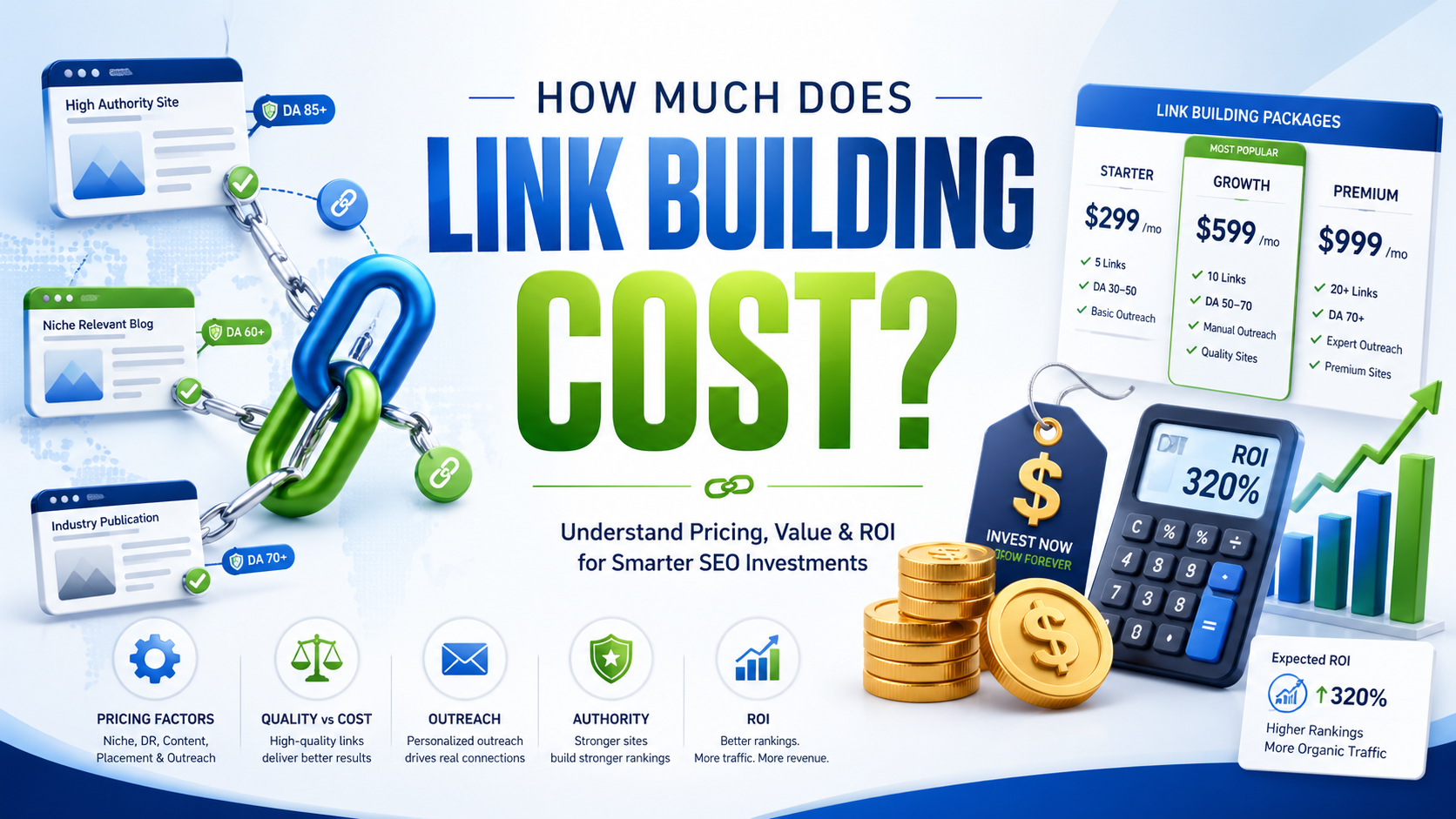
| TL;DR Most businesses pay $150–$1,000 per quality backlink in 2026, with the sweet spot for mid-tier editorial links landing around $300–$500. Monthly agency retainers run $2,000–$15,000+ depending on link volume and domain authority targets. Cheap links ($20–$80) are almost always a liability-not an asset. Google has never been better at identifying them. The right budget depends on your niche, competition, and whether you’re chasing quick wins or compounding long-term authority. 75% of SEOs expect link building costs to keep rising through 2027. Getting started at current rates is a strategic advantage. |
Let’s Be Honest: Link Building Pricing Is Confusing on Purpose
If you’ve spent any time searching for link building quotes, you know the drill. One agency says $500 a month. Another says $5,000 a month. A freelancer on Fiverr offers 50 backlinks for $25. And every provider is somehow the ‘best.’
So when someone actually Googles “how much does link building cost,” they’re not just looking for a number – they’re trying to cut through an industry that has historically been murky about pricing for a reason. Providers who obscure cost are often hiding quality problems.
This guide does the opposite. Drawing on 2026 market data, real agency pricing, and a healthy dose of Reddit-level skepticism, we break down exactly what you’ll pay, what you’re actually getting, and when it’s worth it.
What Does Link Building Actually Cost in 2026?
The short answer: anywhere from $0 to $10,000+ per link. But that range is useless without context. Here’s what the market actually looks like broken down by quality tier:
| Quality Tier | Cost Per Link | Typical DR Range | Best For |
| Budget / Low | $20–$150 | DR 10–30 | Risky. Often PBNs or low-traffic sites. Avoid. |
| Entry-Level | $150–$300 | DR 25–45 | New sites, low-competition niches |
| Mid-Tier | $300–$600 | DR 40–65 | Growth-stage brands, most industries |
| Premium | $600–$1,500 | DR 65–80 | Competitive markets, SaaS, finance, health |
| Elite / Editorial | $1,500–$5,000+ | DR 80+ | Forbes, TechCrunch-level digital PR placements |
The average price an SEO professional is willing to pay for a single high-quality backlink in 2026 is $508.95, according to Editorial.link’s 2026 Link Building Statistics report. That number is up significantly from prior years, and 80.9% of industry practitioners expect costs to climb further.
| Quick reality check: A DR 70 link from a site with 200 organic monthly visitors is not worth $800. Domain Rating is a proxy – not a quality certificate. Always cross-reference organic traffic alongside DR before accepting any placement. |
Link Building Cost by Method: What You’re Actually Paying For
Not all link building is created equal – and the pricing reflects that. The strategy you choose determines what you’re paying for: research time, writer fees, editorial relationships, and publisher leverage. Here’s how costs break down across the most common methods.
| TL;DR Guest posts cost $150–$1,500+ depending on the publisher’s authority. Niche edits are faster and often cheaper ($100–$700). Digital PR is high-risk, high-reward – costing $2,000–$15,000/month but capable of landing DR 90+ editorial links. |
| Method | Cost Range | Avg. DR Outcome | Key Trade-Off |
| Guest Posting | $150–$1,500+ | DR 30–70 | High-effort; best for topical relevance & anchor control |
| Niche Edits / Link Insertions | $100–$700 | DR 30–65 | Fast wins; less content friction; quality varies widely |
| Digital PR / Reactive PR | $2,000–$15,000/mo | DR 70–95+ | Best ROI ceiling; zero guarantee; slowest to deliver |
| HARO / Featured.com | $0–$500 (time cost) | DR 60–90+ | Free but time-intensive; availability-dependent |
| Resource Link Building | $150–$600 | DR 40–70 | Durable placements; slow prospecting process |
| Broken Link Building | $100–$400 | DR 30–65 | Low-volume but strong conversion rates |
| PBN / Paid Link Farms | $10–$100 | DR 50–80 (fake) | High penalty risk. Google identifies these at scale. |
Guest Posting: The Industry Workhorse
Guest posting remains the most widely used paid link building tactic in 2026. You create original content, place it on a third-party website, and earn a contextual backlink. The cost covers prospect research, outreach, content creation, negotiation, and reporting.
What to expect to pay: DA 20–30 sites land around $150–$300. DA 30–50 jumps to $300–$600. DA 50+ starts at $600 and can easily exceed $1,500 for marquee publications.
The price difference usually comes down to editorial friction – high-DR publishers demand longer, more expert-level content and have strict review processes that take weeks, not days.
Niche Edits: The Faster Alternative
A niche edit (also called a link insertion) places your link within an already-published, indexed article. There’s no new content required – you’re just negotiating placement into existing content. This makes niche edits faster to execute and often cheaper than guest posts, but the quality ceiling is lower since you’re relying on a page that’s already live rather than freshly crafted content built around your topic.
Digital PR: The Highest-ROI (and Highest-Risk) Play
Digital PR creates newsworthy assets – data studies, original surveys, expert commentary, reactive news hooks – and pitches them to journalists who link back organically. This is how you land mentions on Forbes, TechCrunch, Healthline, and Nasdaq.
A single successful digital PR campaign can earn 20–50+ links from DR 80+ publications. A flopped one can eat your entire monthly budget and deliver zero. Per-link cost ranges from under $50 (a viral campaign) to $3,000+ (a tough month). Most campaigns run on retainers of $3,000–$15,000/month.
| AI Visibility Bonus: Digital PR earns brand mentions alongside backlinks. According to Ahrefs analysis across 75,000 brands, brand mentions correlate 3x more strongly with AI Overview visibility than backlinks alone (0.664 vs. 0.218). For brands optimizing for ChatGPT, Perplexity, and Google’s AI features, digital PR is increasingly essential – not optional. |
Monthly Retainer Packages: What Does a Full Campaign Cost?
Most businesses don’t buy individual links – they engage link building services on a monthly retainer or package basis. Here’s what the market delivers at each price point in 2026:
| Monthly Budget | Typical Links Delivered | Avg. DR Range | Best For |
| $500–$2,000 | 3–8 links/month | DR 20–40 | New/small websites, local businesses |
| $2,000–$5,000 | 8–15 links/month | DR 35–55 | Growing SMBs, mid-competition niches |
| $5,000–$10,000 | 15–30 links/month | DR 50–70 | Established brands, competitive verticals |
| $10,000–$25,000 | 25–60 links/month | DR 60–80+ | Enterprise, national SEO, SaaS scale |
| $25,000+ | Custom volume | DR 70–90+ | Global brands, high-stakes competitive domination |
According to a 2026 survey by uSERP, 46.5% of respondents spend $5,000–$10,000 per month on link building alone. Another 18% spend more than $10,000 monthly. The “under $1,000” crowd is largely chasing shortcuts – and often paying for it in the form of algorithmic penalties or stagnant rankings.
The competitive-intelligence approach: If the top-ranking site in your niche builds 15 links a month, matching their pace is a baseline, not a goal. Outpacing them by 1.5–2x is what actually moves rankings. Calculate your minimum viable budget from your competitors’ velocity, not from what feels affordable.
Agency vs. Freelancer vs. In-House: Where Should Your Budget Go?
| TL;DR Agencies offer the best quality-to-consistency ratio but cost the most upfront. Freelancers are flexible and cheaper but unpredictable. In-house teams give you control but cost $90,000–$140,000+ annually in fully-loaded overhead before a single link is built. |
| Provider Type | Typical Cost | Quality Ceiling | Key Risk |
| Budget Freelancer | $30–$100/link | Low–Medium | Inconsistent quality; PBN risk; no accountability |
| Experienced Freelancer | $150–$400/link | Medium–High | Single point of failure; no team backup |
| Boutique Agency | $300–$700/link | High | Variable processes; vet carefully |
| Premium Agency | $500–$1,500/link | Very High | Higher upfront cost; slower to scale |
| Digital PR Agency | $700–$2,000+/link (effective) | Highest | No link guarantee; requires sustained investment |
| In-House Team (annual) | $90,000–$140,000+/yr | Variable | 6–12 month ramp-up; fixed overhead regardless of output |
The True Cost of In-House Link Building
Many marketing directors assume that building links in-house saves money. The math usually tells a different story. A realistic lean in-house operation in the US requires at minimum: a link building manager ($40,000–$60,000/year), outreach assistants ($22,500/year), an SEO content writer ($24,000–$50,000/year), and tool subscriptions for Ahrefs, SEMrush, Hunter.io, and outreach platforms ($3,600–$8,000/year).
That’s a base cost of $90,100 per year on the lean side – or $140,000+ for a properly resourced operation. And that’s before accounting for the 3–6 month ramp-up period before an in-house team hits full output velocity.
As a rule of thumb: in-house makes sense once you’re consistently spending $15,000+/month on link building and have the internal SEO leadership to manage and QA the work. Before that threshold, agencies almost always deliver better ROI per dollar.
The Freelancer Middle Ground
Freelancers represent a viable middle option – but with asterisks. Experienced freelancers (with verifiable placement portfolios and transparent pricing) can deliver quality at $150–$400/link. The risks are coverage gaps when they’re unavailable, no backup team, and difficulty scaling. Start any freelancer engagement with a paid test order on 2–3 links before committing to a larger volume.
What Factors Drive Link Building Costs Higher?
Understanding why prices vary so dramatically helps you audit any proposal you receive. The following factors are the primary cost drivers in 2026:
• Domain Authority / DR Tier: Higher-authority publishers charge more because their audience, traffic, and editorial standards are higher. A DR 80 site may charge 5–10x more than a DR 40 site.
• Industry / Niche Competition: Finance, legal, healthcare, and SaaS verticals see the highest per-link costs ($8,406/month average minimum in competitive niches, per Editorial.link). Education, lifestyle, and gaming tend to be significantly cheaper.
• Content Requirements: Many high-DR publishers require 1,200–1,800 word, expert-level articles. Quality SEO content writing costs $150–$400 per article for standard pieces, and $500–$1,000+ for highly technical SaaS or medical content.
• Link Type: DoFollow links command a premium over NoFollow. In-content editorial links cost more than sidebar or footer placements. Anchor text specificity also influences price.
• Outreach Labor: Manual email outreach, inbox follow-up, negotiation, and placement tracking are time-intensive. Services that skip corners on this deliver weaker links.
• Publisher Demand Surge: Over the past two years, publishers have raised placement fees 20–40% because they fully understand the commercial value of their backlink inventory. This is a market-wide trend, not a provider quirk.
Red Flags: When ‘Cheap’ Link Building Costs You Everything
| The most expensive link building mistake you can make is buying cheap links that trigger a Google manual action or algorithmic penalty. Recovering from a link-based penalty can take 6–18 months and cost far more in lost organic revenue than any ‘savings’ from bargain backlinks. |
If you’re evaluating a provider and see these signals, walk away:
• Pricing below $80/link with no clear explanation of site selection criteria
• No transparency about the actual sites you’ll be placed on (no samples, no live examples)
• “Guaranteed rankings” alongside link building promises – no one can guarantee rankings
• Bulk packages (“500 links for $199”) – these are link farms at scale
• Sites with inflated DR but under 500 real monthly organic visitors
• Links from sites with no human editorial presence or content published daily in bulk
• Anchor text manipulation at scale – exact-match anchors on 70%+ of links is a penalty waiting to happen
A study referenced by Backlinko shows that top-ranking pages have significantly more high-quality backlinks than pages in lower positions – but the key word is “quality.” A single DR 65 editorial link from a legitimate industry publication will consistently outperform 20 DR 70 PBN links that Google identifies and ignores (or flags).
How to Budget for Link Building Based on Business Size
There’s no universal link building budget. But there are reasonable benchmarks based on business stage, competition level, and growth ambition. Agencies typically allocate 32–36% of total SEO spend to link building – use that ratio as a starting calibration point.
| Business Type | Recommended Monthly Budget | Links/Month Target | Strategic Focus |
| Local / Small Business | $500–$2,000 | 3–8 links | Local citations + topical authority in geo |
| E-Commerce (Starter) | $2,000–$5,000 | 8–15 links | Category & product page authority |
| E-Commerce (Growth) | $5,000–$10,000 | 15–25 links | Competitive category domination |
| B2B SaaS (Early) | $3,000–$7,000 | 10–20 links | Domain authority + transactional terms |
| B2B SaaS (Competitive) | $7,000–$20,000 | 20–40 links | Aggressive competitor displacement |
| Enterprise / National | $15,000–$50,000+ | 40–100+ links | Full-funnel authority + digital PR |
The 3-Month Pilot Rule: Most link building takes 3–6 months to show measurable ranking impact. Commit to at least 90 days before evaluating results. A 30-day test provides no meaningful data and only wastes the setup investment.
Is Link Building Worth the Cost? Calculating ROI
Link building delivers an average ROI of 702% for B2B companies – the highest of any tracked marketing channel in 2026, per LinkBuildingHQ data. But that number is an average across well-executed campaigns. Poorly targeted link building against the wrong keywords in oversaturated niches can deliver far less.
The Siege Media ROI Formula (Adapted)
One practical framework for calculating whether link building makes financial sense for your business:
• Find the top-ranking competitor in your vertical and pull their Ahrefs Traffic Value (the estimated monthly cost to replicate their organic traffic via paid ads)
• Divide that Traffic Value by their total number of linking root domains
• Multiply by 24 (approximate link lifespan in months) to get the Lifetime Link Value
• Aim for a cost-per-link that is no more than 1/10th of your calculated Lifetime Link Value
Example: If the top competitor has $80,000/month in Traffic Value and 2,000 linking root domains, the average monthly value per link is $40. Lifetime link value = $40 x 24 = $960. Under this model, you should pay no more than $96/link for a positive 10:1 ROI ratio. If your niche’s math doesn’t support the cost, manual link building may not be the right investment – and digital PR or content-first strategies may be more efficient.
| 75% of SEOs expect link building costs to rise over the next two years (Reporter Outreach, 2026). Publisher fees are increasing, AI search is elevating the value of brand mentions, and quality editorial inventory is limited. Acting now locks in relationships and pricing momentum before the next cost cycle. |
2026 Link Building Pricing: Industry Benchmarks at a Glance
| Pricing Category | Low End | High End |
| Cost per link (budget tier) | $20 | $150 |
| Cost per link (mid-tier) | $300 | $600 |
| Cost per link (premium) | $600 | $1,500 |
| Cost per link (elite/digital PR) | $1,500 | $5,000+ |
| Monthly agency retainer (starter) | $500 | $2,000 |
| Monthly agency retainer (growth) | $2,000 | $10,000 |
| Monthly agency retainer (enterprise) | $10,000 | $50,000+ |
| In-house team annual cost (lean) | $90,100 | $140,000+ |
| Digital PR campaign (per campaign) | $2,000 | $15,000+ |
| Average SEO willingness-to-pay (per link) | $508.95 | (industry avg. 2026) |
| % of SEO budget allocated to link building | 32.1% (agencies) | 36% (in-house) |
Frequently Asked Questions
How much does link building cost for a small business?
Small businesses with limited competition can see results with $500–$2,000/month, targeting 3–8 quality links per month in the DR 25–45 range. Local businesses benefit from combining link building with local citation building for faster results in geo-targeted search.
Is it better to buy links or earn them organically?
“Earning” links organically (through content, PR, and digital marketing) is Google’s preferred model – and it scales better long-term. But organic link earning alone is slow and unpredictable, especially for newer domains. Most competitive brands combine earned links (via digital PR and great content) with strategic link placement (via guest posts and niche edits) to accelerate domain authority.
Can I build links for free?
Yes – through time-intensive tactics like HARO/Featured.com responses, broken link outreach, forum participation, and building genuinely linkable assets. Free link building isn’t actually free; it costs significant staff time. Calculate your fully-loaded hourly cost and compare it to agency rates – you may be surprised how competitive professional services are by comparison.
How long does it take for link building to work?
Most well-executed link building campaigns show measurable ranking movement within 3–6 months. Brand-new domains may take 6–12 months before individual link investments reflect in rankings. Patience is non-negotiable – which is also why you should start link building campaigns before you need results, not after.
Are cheap links ever worth it?
Rarely. Below $80/link, you’re almost always buying from link farms, automated networks, or publishers with no real audience. These links provide minimal authority transfer, get devalued or ignored in Google’s next core update, and occasionally trigger manual actions. The risk-to-reward math simply doesn’t work in your favor. If budget is tight, buy two high-quality links over ten cheap ones every time.
Final Takeaways: What Should You Pay for Link Building in 2026?
The question “how much does link building cost” doesn’t have one answer – but it does have a right framework. Here’s what every business owner and marketer should internalize before signing a contract:
• Quality over quantity, always: One DR 65 editorial link is worth more than 20 DR 65 links from sites with fake traffic. Vet every provider’s placements against real organic traffic data, not just domain metrics.
• Budget for consistency, not one-time bursts: Link building compounds over time. A steady $3,000/month for 12 months outperforms a $36,000 one-time campaign executed over 90 days in almost every case.
• Price follows difficulty, not value: The reason a DR 80 link costs more isn’t just prestige – it’s the genuine labor required to earn placement in a competitive editorial environment. Respect that math.
• Factor in AI search: In 2026, link building is no longer just about Google rankings. Brand mentions alongside backlinks are increasingly the signal that AI systems like ChatGPT, Perplexity, and Google’s AI Overview use when recommending your brand. Digital PR is no longer a ‘nice to have’ – it’s a core part of future-proofing your search visibility.
• Expect prices to rise: 80.9% of SEO professionals expect link building to become more expensive in the next 2–3 years. Locking in agency relationships and publisher placements at today’s rates is a strategic investment, not just a tactical one.
Bottom line: The businesses winning in organic search in 2026 are not the ones who found the cheapest link building vendor. They’re the ones who invested consistently in quality placements, maintained realistic expectations about timelines, and treated link building as a long-term compounding asset – not a short-term expense to minimize.